Every capability you need to govern AI agents at runtime
From discovery to audit, SinzAI provides the only runtime governance layer purpose-built for enterprise AI agent deployments.
Detect → Map → Govern → Prove → Undo
Every phase of the governance lifecycle. No gaps, no blind spots.
Detect
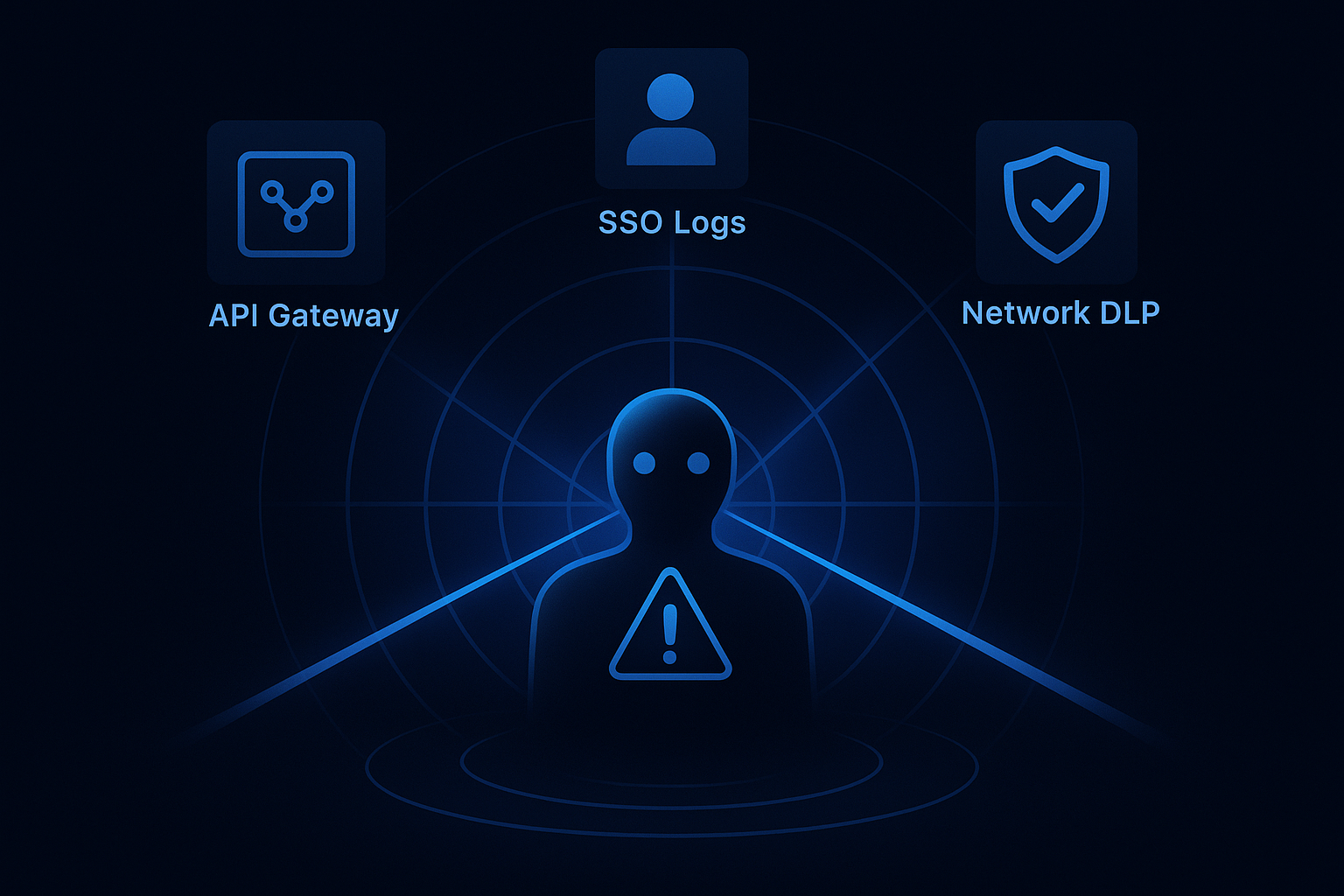
SinzAI discovers every AI agent operating in your environment — whether sanctioned or shadow. Agents are found through multiple data sources:
- API Gateway Logs — Agents identified by unique API key patterns and model signatures
- Network DLP — Traffic analysis detects model API calls and LLM interactions
- SSO / IdP Logs — Service accounts and machine identities correlated to agent behavior
- Expense Audits — Cloud AI spend anomalies flag uncatalogued agent deployments
Map
Every data store an agent can reach is classified by sensitivity and region. SinzAI builds a live dependency graph that shows exactly which agents can touch which data.
- Sensitivity Classification — PII, PHI, PCI, financial, and internal data automatically tagged
- Regional Data Governance — Data residency mapped to GDPR, CCPA, and local regulations
- Access Path Analysis — Every route from agent → data store traced and documented
Data Store Map
customer_pii_dbus-east-1warehouse:analyticsus-east-1crm:contactseu-west-1sendgrid:campaignsus-west-2Govern
Every agent gets a registered purpose, scoped data access, and a cryptographic identity. Short-lived credentials, HITL gates, and a global kill switch give you fine-grained control.
Prove
One policy written once maps to every major AI governance framework — producing evidence stakeholders can trust and a clear ship/no-ship decision at every deployment.
One-tap audit reports — Continuous, automated evidence from the action ledger, enforcement logs, and trust score history. Ship with confidence, audit on demand.
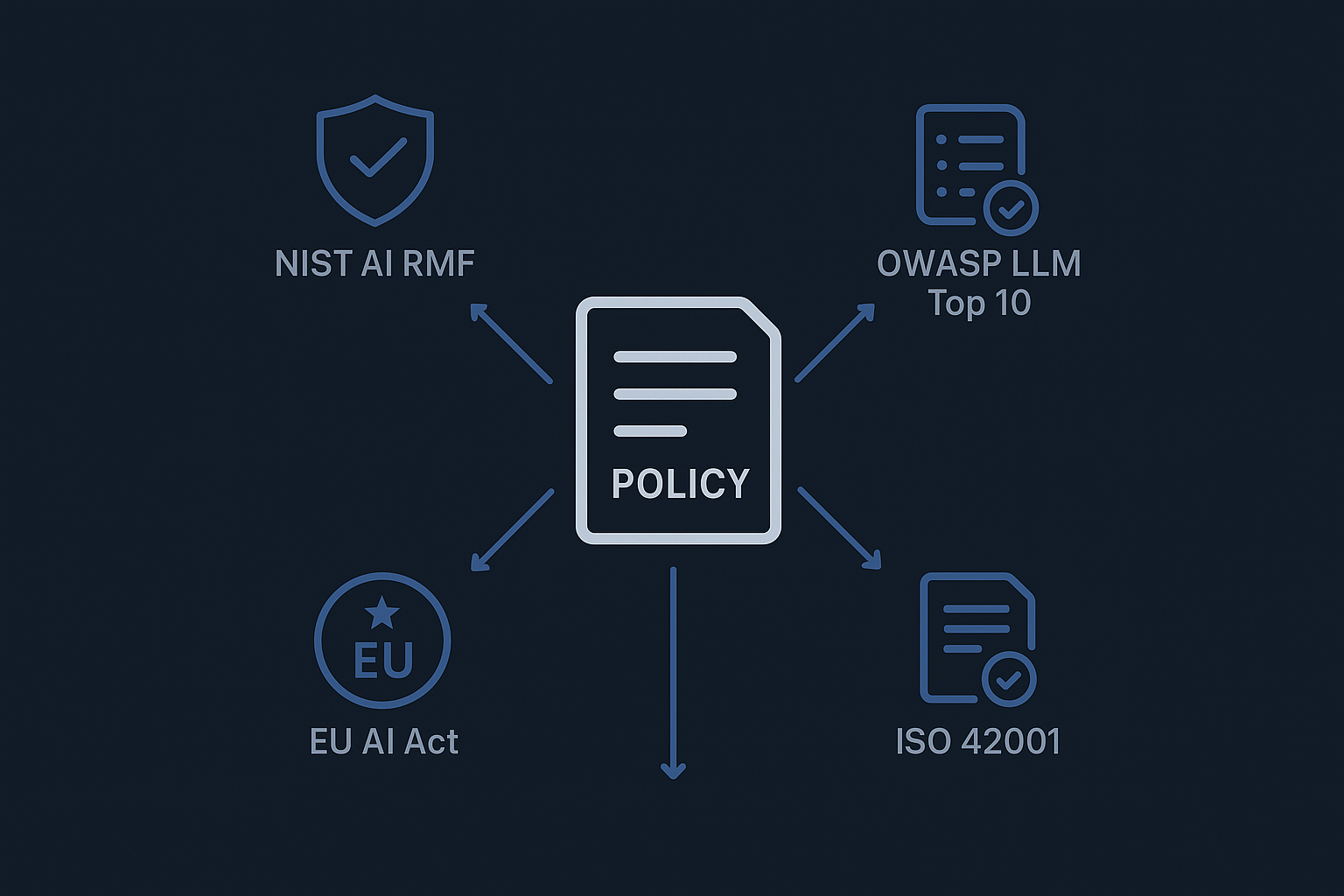
Every policy-to-framework mapping is re-evaluated when a policy, model, agent scope, or owner changes. Your audit trail never goes stale.
Undo
Every action an agent takes is recorded in an append-only audit ledger. When something goes wrong, roll it back with one click — no matter how many systems were touched.
- Full Action Ledger — Every agent write, decision, and data access — tamper-evident
- One-Click Rollback — Reverse any agent action across all connected systems
- Dependency-Aware Reversal — Rollback cascades correctly through dependent operations
Architecture deep-dive
Every agent action passes through seven layers of runtime governance. Each layer is independently verifiable.
Traceability
Every agent action, decision, and data touchpoint is recorded in an audit-grade append-only ledger. Tamper-evident by design — any modification breaks the chain.
Containment
Agents that show anomalous behavior are automatically quarantined. Isolation happens at the network, data, and identity level — a quarantined agent can't propagate harm.
Reversibility
Every agent write is recorded with full state before and after. One-click rollback restores the prior state across all affected systems, with dependency-aware reversal.
Decision Authority
Human-in-the-loop gates block all external side effects until a human approves. No autonomous writes to production data, customer communications, or financial systems.
Failure Protocols
Configurable retry, degrade, halt, or notify on failure. Silent errors are impossible — every failure produces an auditable event.
Observability
Streaming evidence feed with real-time trust scores — always recomputed from runtime signals, never a stale snapshot. Every signal is explainable.
Intervention
Global kill switch halts every agent in the organization with one click. An escalation chain ensures the right person is notified within seconds.
CISA-aligned. These seven layers map directly to the five risk categories in CISA's May 2026 "Careful Adoption of Agentic AI Services" guidance: privilege escalation, design/configuration flaws, behavioral misalignment, cascading failures, and accountability opacity.
Memory Governance
"Memory informs. Authority resolves. Enforcement executes."
No other solution prevents agents from acting on remembered context that has outlived authorization. Here's how it works:
See the difference
Runtime governance vs. no governance. Proactive control vs. checklist compliance.
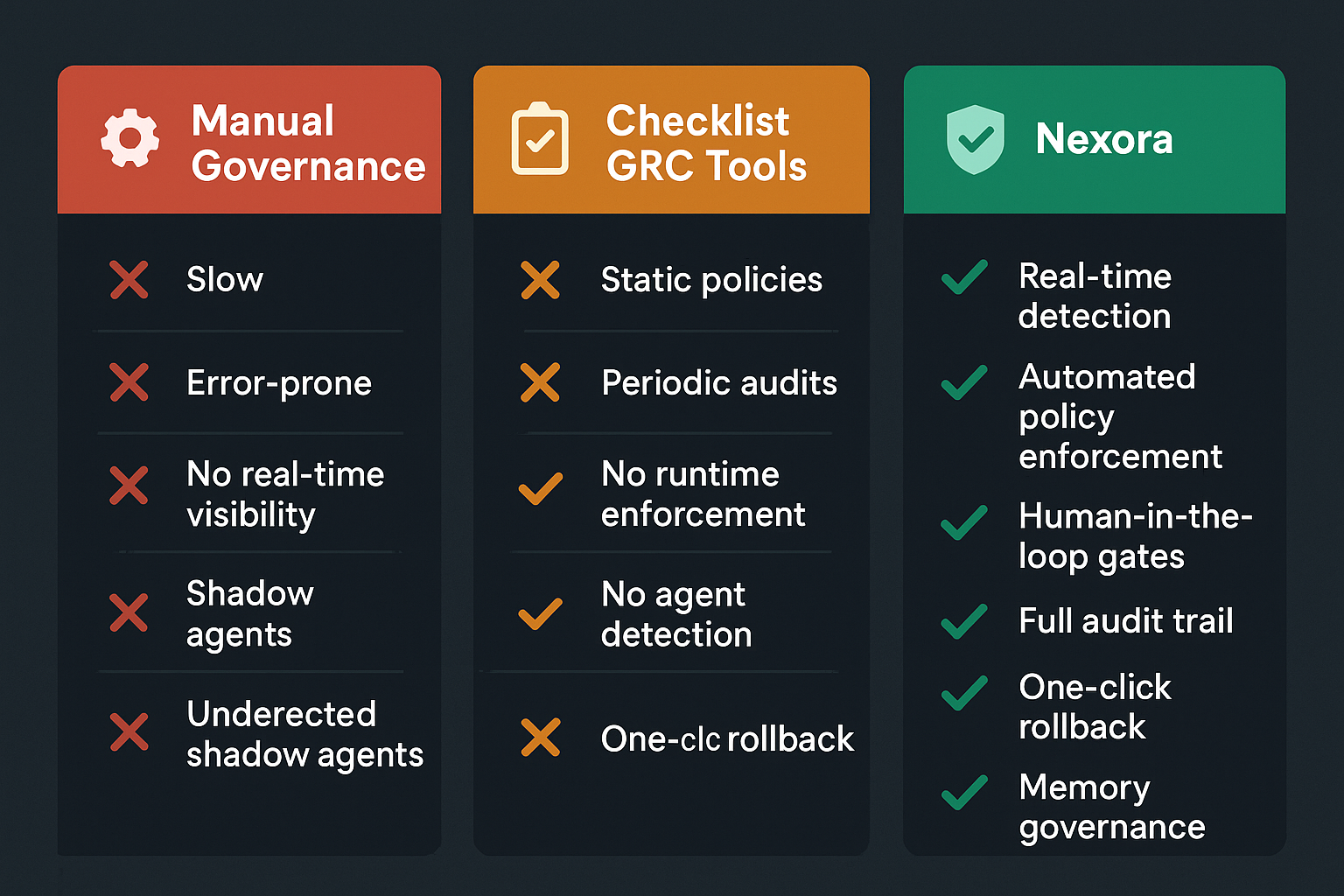
SinzAI vs. No Governance
| Capability | With SinzAI | Without Governance |
|---|---|---|
| Agent Discovery | Continuous — agents found within minutes of first API call | Manual spreadsheets or nothing |
| Data Store Mapping | Auto-classified by sensitivity with toxic combination alerts | Unknown data exposure |
| Identity & Access | Cryptographic identity with short-lived credentials | Long-lived API keys or shared secrets |
| Human Oversight | HITL gates on all external side effects | Agents act with full autonomy |
| Incident Response | Auto-quarantine + one-click kill switch | Manual detection and slow containment |
| Action Reversibility | Full ledger with one-click rollback | Manual cleanup or data loss |
| Compliance Mapping | Single policy crosswalks to 4+ frameworks | Duplicate work for each framework |
| Memory Governance | Context sweep on authorization expiry | Stale context persists indefinitely |
| Cost Controls | Per-team token budgets with real-time tracking | Unbounded AI spend |
SinzAI vs. Checklist GRC Tools
| Dimension | SinzAI | Traditional GRC |
|---|---|---|
| Approach | Runtime enforcement — governs agents in real time | Policy documents and periodic reviews |
| Discovery | Automated agent discovery across infra signals | Manual self-reporting by teams |
| Policy Enforcement | Block, quarantine, or halt at runtime | Detect and report after the fact |
| Trust Scoring | Real-time score from runtime signals (never stale) | Annual risk assessments |
| Action Ledger | Append-only, tamper-evident, with rollback | Audit logs (often not agent-specific) |
| Compliance Mapping | One policy → NIST, OWASP, EU AI Act, ISO 42001 | Separate control sets per framework |
| Memory Governance | Unique — context sweeps on auth expiry | Not addressed |
| HITL Gates | Granular per-action HITL approval flows | Not applicable |
| Kill Switch | Global and per-agent instant halt | Not applicable |
| Deployment | Runtime layer — deploys alongside agents | Separate system, separate processes |
Traditional GRC tools were built for static compliance — not for runtime AI agent governance. SinzAI is the first product designed for the speed and autonomy of modern AI agents.
Ready to see it in action?
Launch the live console to explore agents, policies, the audit ledger, and compliance mappings yourself.