Architecture
Seven-Layer Architecture
SinzAI's architecture is built on seven independent but composable layers. Each layer addresses a specific dimension of AI agent risk. Together, they form a complete runtime governance substrate — deploy one, several, or all seven depending on your risk posture.
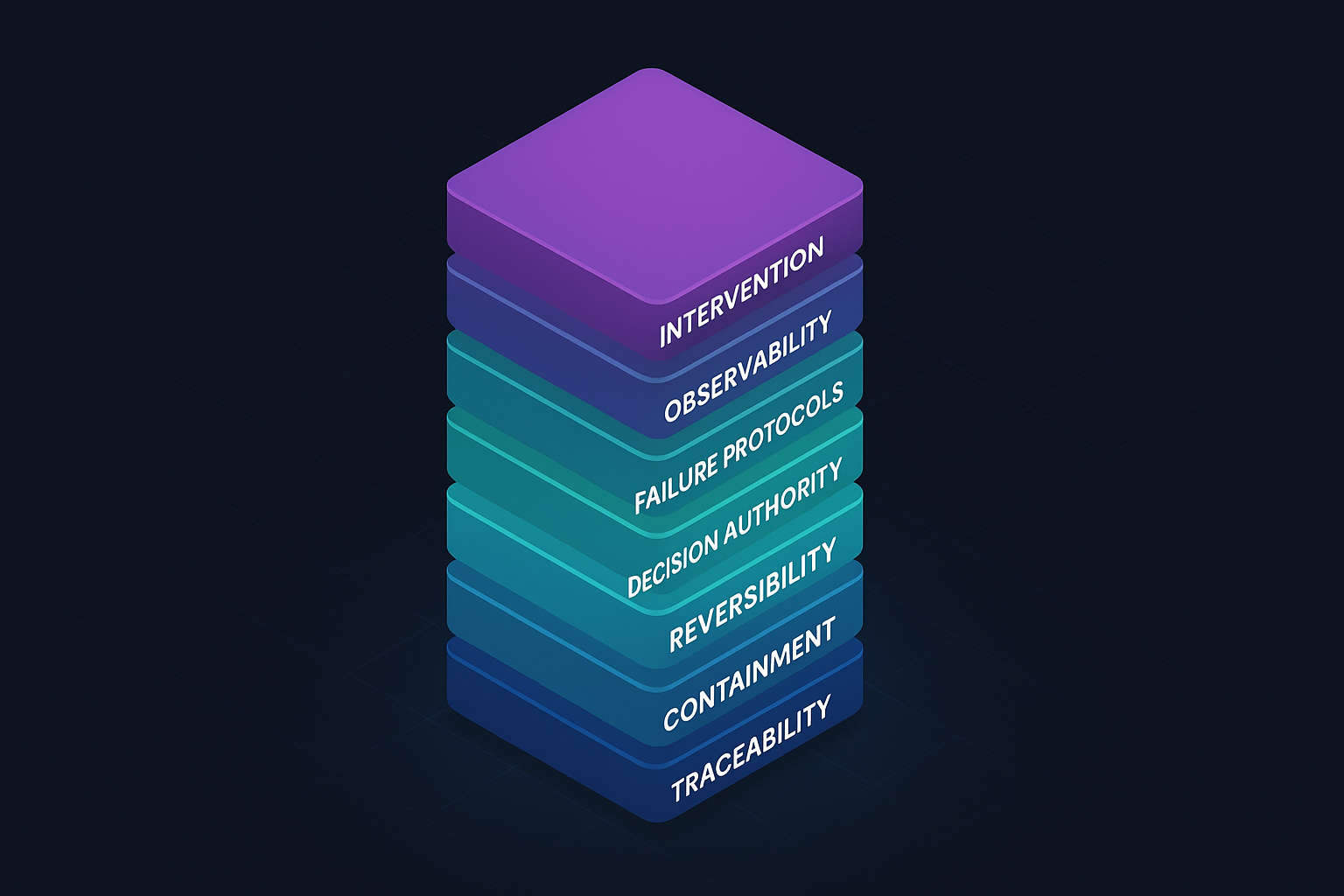
The seven layers compose from the bottom up: Traceability is the foundation; Intervention is the ultimate safeguard.
Traceability
Every action, permanently recorded.
An audit-grade, append-only ledger captures every agent action — reads, writes, API calls, data accesses, and side effects. Each entry is traceable to the agent's cryptographic identity, model version, prompt structure, and data source. No agent credential can write to or delete from the ledger store.
- Append-only with cryptographic chaining (each entry hashes the prior)
- Agent credentials have zero write access to the ledger store
- Every entry links to: agent ID, model version, prompt fingerprint, data source
- Tamper evidence: any modification is cryptographically detectable
Containment
Quarantine the threat. Keep everything else running.
When an agent exhibits anomalous behavior or violates a policy, SinzAI can immediately isolate it — quarantining the agent's execution environment while the rest of the system continues operating normally. Containment is configurable: isolate the agent, its team, or its entire data scope.
- Three containment scopes: agent-level, team-level, data-scope-level
- Quarantined agents retain state but lose all external access
- Automatic containment triggers based on trust score thresholds
- Manual quarantine from the console or API with instant effect
Reversibility
One click. Every write undone.
Every agent write is recorded with enough context to reverse it. The action ledger tracks the before-state of modified records, enabling one-click rollback of any write operation — from a single API call to an entire agent session. Rollbacks are themselves recorded as auditable events.
- One-click rollback at any granularity: single action, session, or agent lifetime
- Before-state captured for every write operation
- Rollback events are themselves ledgered and auditable
- Tamper-proof: rollback history cannot be altered or deleted
Decision Authority
Humans in the loop where it matters.
Human-in-the-loop (HITL) gates intercept agent actions that produce external side effects — sending emails, writing to production APIs, executing financial transactions above thresholds, or deleting data. Configurable per agent, per action type, and per data sensitivity level.
- HITL gates on all external side effects: emails, API writes, deletions, >$10k transactions
- Configurable per agent, per action type, per data classification
- Approval workflows integrate with Slack, Teams, email, and webhook
- Timeout-based escalation: unapproved gates auto-deny after configurable TTL
Failure Protocols
When guardrails trip, the system knows what to do.
Every policy violation or guardrail trip triggers a defined protocol — retry with backoff, degrade gracefully, halt the agent, or notify the on-call team. Protocols are composable: a single failure can trigger multiple responses simultaneously (halt + notify + log to SIEM).
- Four response actions: retry (with exponential backoff), degrade, halt, notify
- Composable: a single violation can trigger multiple responses
- SIEM integration: all failure events stream to Splunk, Datadog, or custom webhook
- Circuit breakers prevent cascading failures across agent fleets
Observability
Streaming evidence. No blind spots.
A real-time streaming feed of every governance event — policy evaluations, trust score changes, HITL gate activations, quarantine events, and rollbacks. This evidence feed is designed for integration with existing observability stacks: Datadog, Grafana, Splunk, and custom SIEM pipelines.
- Real-time event stream with <100ms latency from action to evidence
- Structured events in JSON with full context
- Pre-built dashboards for Datadog, Grafana, and Splunk
- Custom webhook destinations for any observability pipeline
Intervention
The kill switch. Instant. Irreversible.
A single kill switch that instantly revokes all agent credentials, halts all in-flight operations, and triggers the failure protocol for every active agent. Designed for the worst-case scenario — deployable from the console, API, or a physical webhook endpoint.
- Single action: revoke all credentials, halt all agents, notify all teams
- Deployable from console, CLI, API, or physical webhook
- Sub-second propagation across all agent runtimes
- Post-kill audit report automatically generated within 60 seconds